
Load tests of cranes and davits, boats in accordance with ILO and MSC 402 (96)
Comprehensive guide.
Introduction
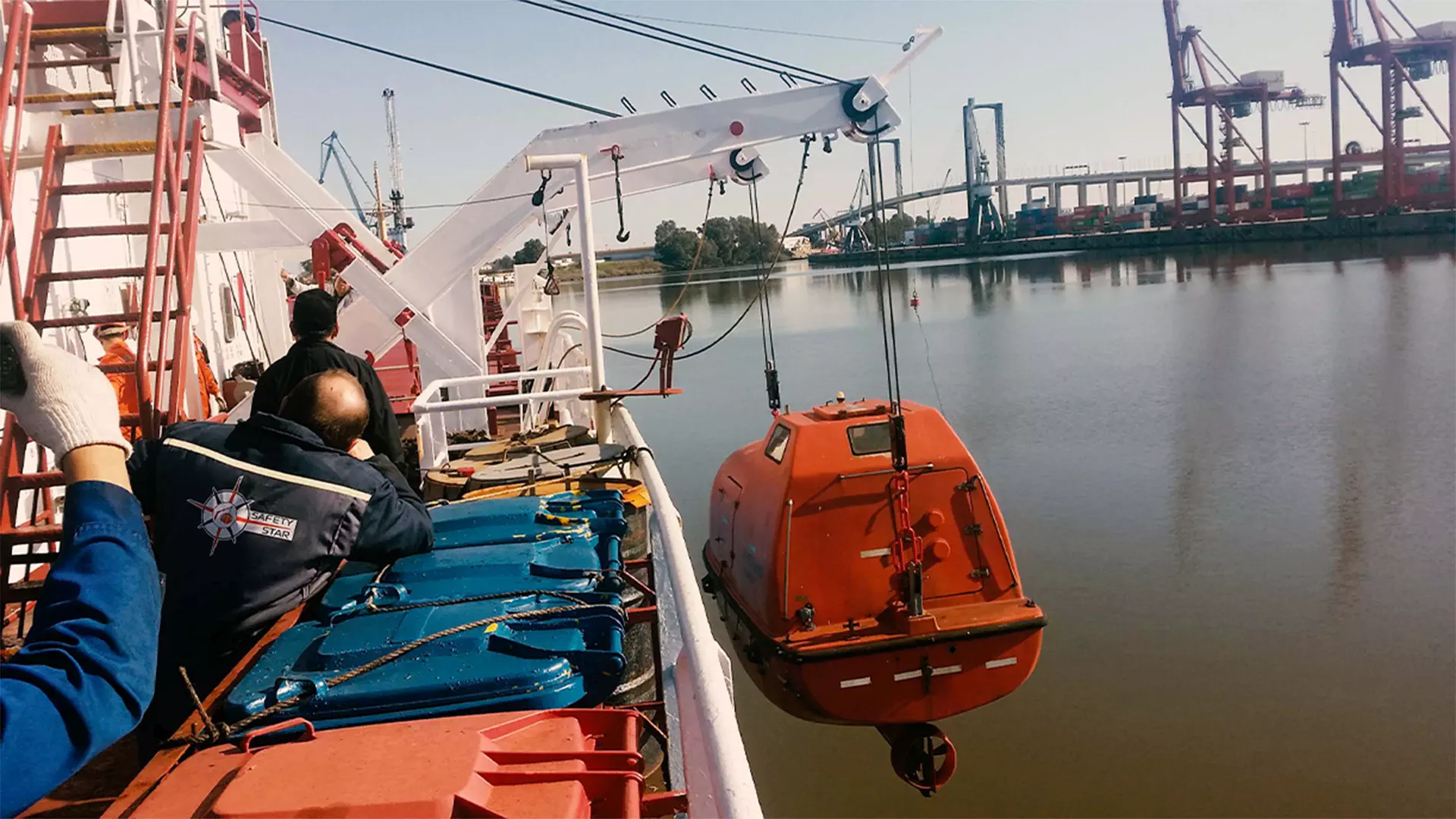
Cranes, davits, boats are some of the most important devices used on ships and floating units. Used for loading, unloading, as well as for operating lifeboats and rescue boats, they are a key element of ship equipment, on which the safety of maritime operations depends. Load tests are of fundamental importance in assessing the efficiency of these devices and their ability to work in demanding sea conditions. In this article, we will discuss in detail the purpose, procedures, and key technical aspects related to carrying out load tests.
Why are load tests performed?
Load tests of cranes, davits, boats are required primarily for two reasons:
- Operational safety – ensuring that the crane, davit, boat will withstand the expected loads, which is particularly essential in the context of dynamic conditions at sea, where the equipment is exposed to forces caused by waves and wind.
- Compliance with regulations – international standards, such as the SOLAS Convention (Safety of Life at Sea) and IMO (International Maritime Organization) and ILO (International Labour Organization) regulations, oblige the owners of units to regularly test deck equipment.
Cranes, davits, boats must be regularly tested to obtain certificates of compliance.
These standards also specify the frequency of tests. In general, inspections are performed annually, but load tests are performed once every 5 years, but in special cases they may be performed more frequently, e.g. after modernization of the device or repair of its main components.
Safety standards and norms
Load tests must comply with international requirements and standards, which allows to guarantee a high level of safety. There are two main types of tests used in the industry:
- Static tests – the crane or davit is loaded with the maximum permissible load, which is held for a specified period without movement. The aim is to check whether the mechanisms and structure withstand the declared load without deformation or damage.
- Dynamic tests – the crane, davit, boat are subjected to a load of SWL + 10%. The efficiency of the device and its stability during lifting and lowering of the load are checked.
Carrying out these tests in accordance with the standards ensures complete operational safety and prevents failures when using the device at sea.
Load testing methods
The process of load testing cranes and davits is a demanding task and consists of several stages.
Equipment used for testing
During load tests, specialized loads are used, such as:
– Water bags – filled with water at the test site, allowing precise adjustment of the load weight.
– Ballasts – e.g. steel or concrete blocks that are easy to control and move.
– Integrated measuring devices – such as dynamometers, which are used to accurately measure and monitor load during testing.
Carrying out these tests in accordance with the standards ensures complete operational safety and prevents failures when using the device at sea.
Test procedure
The load testing process requires precision and consideration of many steps:
1. Preparing the crane for the test – an initial inspection of the equipment is carried out to ensure that it is fully operational and ready for the test.
2. Securing the test site – the equipment is planned to be positioned, and safety zones are designated. Loads that must be certified are also prepared.
3. Carrying out a static test – the device is loaded with the maximum permissible weight. This weight is maintained for a specified time, and then it is checked that the structure has not undergone any deformation.
4. Carrying out a dynamic test – the crane or davit is moved with the load to check its stability and efficiency in motion.
Analysis of results
After the tests are completed, all results are carefully analysed. This evaluation includes a review of load indicators, analysis of detected deformations and an evaluation of the operation of moving mechanisms.
Specialized measuring and control equipment
Load testing requires the use of precise devices to measure and monitor loads. The devices used include:
- Dynamometers – devices that measure the force of the load, which allow for the accurate determination of the actual lifting capacity of the crane.
- Strain gauges – used to measure stress in structural elements, which allows for the detection of even minor cracks or structural changes.
- Data loggers – devices that record the course of the tests and the load values. This data is then analysed, and the conclusions recorded in the documentation.
All measurements and test results must be properly documented, and certificates issued after tests should include details of the tests performed and the equipment’s compliance with applicable standards.
Maintenance of cranes and davits in the context of load tests
Regular maintenance of cranes is essential to maintaining their efficiency and extending their service life. In the context of load tests, maintenance includes:
- Inspection of ropes and chains – particularly susceptible to damage and overloads, which can cause failure during the test.
- Lubricants and oils – proper lubrication of moving parts prevents excessive wear and minimizes friction.
- Inspection of locking mechanisms – these mechanisms, used in cranes and davits, are crucial for the safe use of the device in difficult marine conditions.
Typical problems and solutions encountered during load testing
During load testing, the most common problems include:
- Material fatigue – micro-cracks or minor deformations resulting from repeated overloading. To avoid further damage, additional tests must be performed and, if necessary, structural elements must be replaced.
- Lubrication deficiencies – improperly lubricated elements can lead to mechanisms seizing, so regular lubricant maintenance is essential.
- Corrosion – long-term exposure to seawater and moisture causes crane and davit components to corrode, which can weaken their structure.
If any problems are detected, they must be repaired immediately before the next use of the device.
Summary and recommendations
Load testing is essential to maintaining a high level of safety in marine operations. Regular testing ensures that cranes and davits are in good working order, reducing the risk of failure and accidents. Operators should adhere to established test schedules and ensure that equipment is regularly serviced to ensure that cranes can provide years of full service.
This article is a detailed guide, useful for both operators and service companies that care about the safety of cranes and davits on vessels.